
Volunteer for a research study
Volunteer for research
RECOVER Injury Research Centre is conducting a number of research studies to improve the health outcomes of people injured in road traffic crashes.
Musculoskeletal injury studies
Focus
The Improving health outcomes after musculoskeletal injury research team at RECOVER develops effective diagnosis, assessment and treatment for people with musculoskeletal injury following a motor vehicle crash. Our research includes many different aspects of recovery.
Criteria
We are often looking for volunteers for different studies.
- You must be over 18 years of age; and
- Experiencing musculoskeletal pain, for example neck or back pain
What is involved?
Each study has slightly different requirements - some require the completion of online questionnaires, others involve telephone or face-to-face interviews, whilst some include participation in activities or treatment.
How can I volunteer or find out more?
Do you have chronic whiplash pain (more than 3 months)
Do you have long-term neck pain after a whiplash injury or neck strain?
Interested in having the nerves in your eye examined?
Study title:
Small nerve fibre pathology in chronic whiplash – a corneal confocal microscopy study
What is this research about?
This study seeks to learn about sensory nerves in people with long-term whiplash neck pain. After a whiplash injury, some people recover, and others develop long-term pain. The reasons for ongoing pain after whiplash are not fully understood, however recent research suggests that sensory nerves (that transmit information about pain) may be implicated.
What will you do?
Participation involves undergoing a microscope assessment of the eye by an optometrist, completing some questionnaires, and sensory testing at the neck and leg, which will take no longer than 90 minutes.
This study is done at the Queensland University of Technology School of Optometry and Vision Science at Kelvin Grove. Participants are offered a $50 gift voucher to reimburse for time and travel expenses.
Who can participate?
We are seeking male and female participants aged 18-70 years, with neck pain after a whiplash injury lasting more than 3 months.
How do I participate?
To find out more information, please contact Dr Scott Farrell and the research team on (07) 3346 4791 or scott.farrell@uq.edu.au
Have you had a whiplash injury in the past 3 weeks?
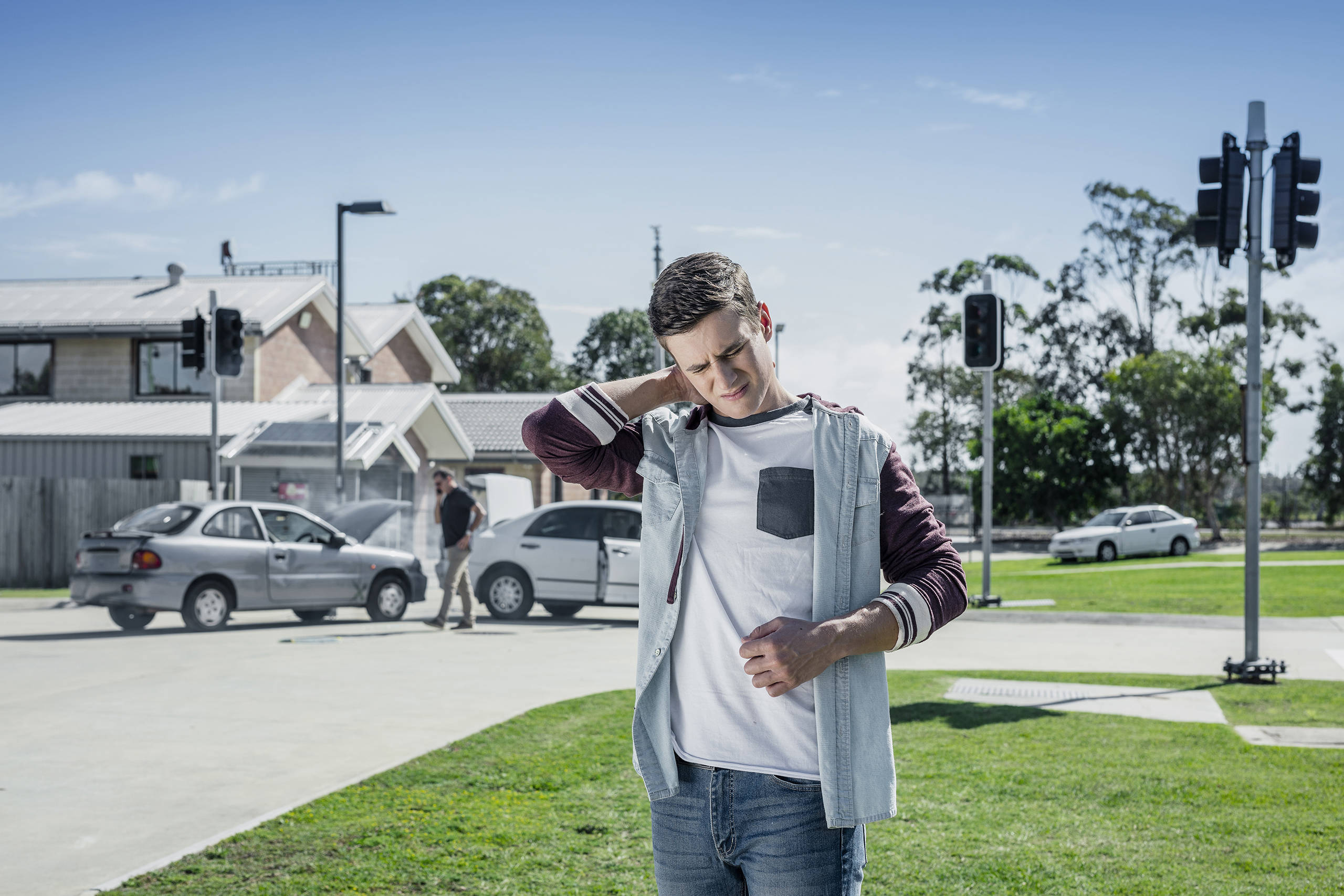 Study title:
Development of small nerve fibre pathology in chronic whiplash-associated disorder
What is the purpose of this research?
Some people recover from a whiplash or neck strain injury, while for other people neck pain can become a long-term problem. Recent research findings suggest that in some people who develop long-term whiplash neck pain, there are changes in the structure and function of small sensory nerve fibres responsible for transmitting information about temperature and pain. This is a phenomenon also noted in other pain conditions such as fibromyalgia. This may be related to the biological mechanisms underlying long-term pain in this condition, so we need to learn more about this to help improve diagnosis and treatment.
The aims of this study are: i) to determine when after a whiplash injury these nerve findings can be observed, and ii) to better understand their clinical significance and possible causes.
Who can participate
We are looking male and female participants aged 18-70 years who are either:
- Pain free, or
- Have neck pain following a whiplash or strain injury, such as from a car crash, within 3 weeks of injury.
What does participation in this research involve?
Participation in this research involves attending the Tess Cramond Pain & Research Centre, RBWH (STARS Building, 296 Herston Road, Herston) for data collection (60-90 minute appointment).
During the appointment we will ask you to complete some questionnaires regarding neck pain (if applicable), general health and psychological symptoms, undertake skin biopsies at the finger and ankle, and collect blood from a vein in your arm.
To reimburse for time and travel expenses, participants will be provided a $50 gift voucher for each appointment attended.
Register your interest
To register your interest, or find out more about this study, please contact Dr Nayomi Ranathunga on 048 602 0691 or email n.ranathunga@uq.net.au
This study has been approved by The University of Queensland Human Research Ethics Committee [Approval No.2022/HE000921].
Have you had a whiplash injury in the past 3 months?

Individuals who have recently experienced whiplash from a road traffic injury are invited to participate in a workshop to help co-design a text message intervention.
Current treatments for whiplash often miss the emotional impact of trauma and aren’t always affordable or easy to access. Our team has co-designed RISE, a new and easy-to-access support program delivered by text message.
About this workshop
Part of this project involves working with people who have recent lived experience of whiplash from a road traffic incident (in the past 3 months) to help co-design the text message intervention.
Responsibilities:
In the workshop, you will take part in group discussions and activities where you can share your ideas and feedback. This feedback will guide us in improving the intervention before it is ready for the pilot study.
Time commitment:
The workshop goes for 2 hours and will be run online.
Remuneration:
To thank you for your time, all participants will be reimbursed $50/hour for the workshop.
Eligibility:
To be eligible to participate, you must be:
18 years or older
a resident of Queensland, and
have recent lived experience of whiplash after a motor vehicle incident (within the past 3 months).
Register your interest
To register your interest, or if you have any questions, please email Jessica Formosa
j.formosa@uq.edu.au.
This project has received ethics approval through the University of Queensland (Project ID: 2023/HE002164).
Physiotherapists - tell us your perspectives on N-of-1 trials and single case designs
Project title:
What is this research about?
Most treatment guidelines are developed based on research that focuses on how groups of patients respond to a treatment on average (i.e., findings from a randomised controlled trial). However, response to treatment may vary substantially from one patient to another. Due to a focus on the average response, studies using traditional research designs may not identify patients who do not respond or who are harmed by a particular treatment. N-of-1 trials and single-case designs have emerged as a rigorous scientific method that can be used to identify individual patient response to treatments. This study aims to explore stakeholder perspectives about the barriers and facilitators for conducting N-of-1 trials and single-case studies in clinical practice.
What will you do?
You will complete an interview in person or via telephone or video call (e.g., Zoom or Teams). Prior to the interview, you will sign a participant consent form, complete a brief online questionnaire collecting information about you, and watch a video describing what N-of-1 trials and single-case designs are. This will take approximately 10 minutes to complete. You will then take part in an interview. During the interview the researcher will ask you a series of questions about your views on N-of-1 trials and/or single-case designs. The interview will be audio-recorded. The interview will take approximately 30-40 minutes to complete. After the interview audio-recording has been transcribed, we will offer you the opportunity to review your interview transcript for data accuracy.
Who can participate?
 We are looking for Australian Physiotherapists of any age with at least one year's experience in clinical practice in the musculoskeletal field.
How do I participate?
The interviews will be conducted via telephone or video call at a time convenient to you.
To find out more information, please contact Associate Professor Jane Nikles by email: catherine.nikles@uq.edu.au or mobile phone 0408 599 033.
Test drive a powered wheelchair simulation in virtual reality

Project Title
Designing a VR Application for Motorised Wheelchair Selection: A User-Centred Approach
What is this research about?
John (JJ) Hitchens’ experiences choosing and learning to use his first powered wheelchair led to the idea for a powered wheelchair simulation using virtual reality (VR). The UQ RECOVER Injury Research Centre is collaborating with John Hitchens to develop a prototype that can be used in clinics to support wheelchair selection and enhance user independence.
To develop the prototype, we brought together wheelchair users, health professionals, and VR experts. Together, they co-designed a simulation that demonstrates how different powered wheelchair drive systems perform in different environments. This simulation will help users select the right wheelchair for their needs and provide basic training on its use.
We need powered wheelchair users to test the prototype and provide feedback
Who can participate?
To test drive the VR simulation, you must be:
- a powered wheelchair or power assist wheelchair user
- able to use a joystick-style controller
- able to travel to the Surgical Treatment and Rehabilitation Service (STARS) facility in Herston, Brisbane.
- over the age of 18.
What is involved?
You will be asked to play the VR-powered wheelchair driving experience for a maximum of 20 minutes. Then, complete a short questionnaire and interview about your experience.
What are the benefits of participating?
- You will be reimbursed $50.
- Parking can be provided at STARS.
- Other travel requirements can be discussed.
Register your interest
For more information, or to register your interest, please email Dr Robert Cuthbert at robert.cuthbert@uq.edu.au
This study has been approved by The University of Queensland Human Research Ethics Committee [Approval No. 2024/HE001503].
Health practitioners: Have you prescribed or implemented digital psychological interventions for pain?
We are inviting clinicians involved in the prescription or implementation of digital psychological interventions (e.g., mobile applications, online modules, virtual reality, AI chatbots) for people with pain, to share their experiences as part of a research study.
We hope these findings will help us better understand how these treatments can be of value to clinicians and be effectively integrated into routine care.
Who can participate
Clinicians (GPs, physiotherapists, exercise physiologists, psychologists, nurses etc. ) who have been involved in prescribing, facilitating, or implementing digital psychological interventions for people living with chronic musculoskeletal or primary pain conditions.
Get involved
Interested in taking part? Please complete the short screening questionnaire.
For more information, contact Chloe-Emily Eather at c.eather@uq.edu.au.
This study has been approved by The University of Queensland Human Research Ethics Committee [Approval No. 2025/HE001067].
Physiotherapists: Help evaluate an online education program for StressModex (Stress inoculation training and exercise)
We are recruiting physiotherapists to help us evaluate the Physiotherapists bIopsyChosocial Online Training (PICOT) platform. PICOT is an online education program for physiotherapists to learn and implement psychological and physical care skills for people after a road traffic injury, such as an acute whiplash injury. The aim is to educate physiotherapists on StressModex (stress inoculation training and exercise) to assist people with their recovery from a road traffic injury.
What’s Involved
Online Modules: You’ll receive access to six PICOT modules. Each one aligns with a session of the StressModex program. You’ll be asked to complete one module per week over six weeks, at your own pace.
- Module 1: ~45 minutes
- Module 3: ~30 minutes
- Other modules: ~15 minutes each
- Q&A panel discussion videos (~35 minutes total): 9 short videos (2–6 minutes each)
Baseline Survey: Before starting the modules, you’ll complete a short survey (10-15 minutes) collecting basic information (e.g., demographics, clinical experience, digital literacy, pain attitudes and beliefs, and confidence in delivering StressModex).
Module Feedback: After completing each module, you’ll be asked to complete a survey (5–10 minutes) to evaluate the learning content.
Qualitative Interview: You will be randomly assigned one module for further evaluation. For this module, a facilitator will schedule an online session with you, during which you’ll complete the module while sharing your screen. The facilitator will observe silently. Afterward, they will conduct a 20-minute interview to gather your feedback.
Final Survey: After completing all six modules, you’ll complete a final survey (15-20 minutes) assessing your confidence and skills in delivering StressModex, your pain attitudes and beliefs, and your overall experience with the modules.
What You’ll Receive
- A certificate of completion for the six StressModex training modules (which may contribute to your CPD).
- A $25 e-gift card to thank you for your time.
Register your interest
Please contact Dr Yanfei Xie (yanfei.xie@uq.edu.au) or Dr Carrie Ritchie (c.ritchie@uq.edu.au) if you are interested in participating the study.
Physiotherapists: Join the PICOT Trial for free StressModex training (psychological and exercise intervention for acute musculoskeletal road traffic injury
Calling all physiotherapy clinics that see patients with musculoskeletal road traffic injuries (e.g. whiplash, back pain after road traffic crash)
The MRFF-funded PICOT trial is underway, and we need more physiotherapists. Do not miss the chance to be part of it. Gain new skills to integrate psychological strategies with physiotherapy care and contribute to nationally significant research led by Prof Michele Sterling.
What is the trial about?
The PICOT trial aims to evaluate two training strategies to improve the uptake of an evidence-based, integrated psychological and exercise intervention (StressModex) for acute musculoskeletal road traffic injury amongst Australian physiotherapists. The trial will primarily measure how you implement the StressModex intervention with patients, but will also collect patient outcomes.
What is involved?
Eligible physiotherapy clinics will be randomly assigned to one of the following training groups (~14 hours of training in total):
- PICOT: 6-week online learning modules + zoom sessions (Physiotherapists bIopsyChosocial On-line Training)
- 2-day in-person training workshops
Both groups will be trained by a clinical psychologist and an expert musculoskeletal physiotherapist.
All costs are covered!
Training is planned to commence in early 2026
Express your interest
To express your interest or get more information: email Dr Chris Papic at picot@uq.edu.au
Men living in remote areas - share your thoughts on digital support for men doing it tough
Do you get stressed or anxious sometimes? If you are a man living in a remote area, I’d like to hear your thoughts on offering digital support for men doing it tough.
Apps, websites and online services like MensLine Australia or MindSpot can help you when life is stressful. These services offer helpful advice and strategies to assist you to take better care of yourself.
Often, men don’t use these services, and I want to understand why. I would like to hear your thoughts, experiences, or those of your mates, in a confidential interview. Your insights will be helpful to other men having a tough time.
Who can participate?
I would like to talk to men who:
- are living in a remote area
- have been stressed, anxious, or depressed sometimes in their life
You don’t need to have used digital health technology before.
What is involved?
A confidential chat with me for up to one hour, either:
- online
- or in-person.
Your personal identity will not be shared.
Reimbursement
You will receive a $75 gift card for your time.
Questions
Please get in touch with Raphael Ohms, UQ PhD Student and nurse, at r.ohms@uq.edu.au
Get involved
Click the link below to go to the registration form.
Men over 45: Share your thoughts on digital support for men doing it tough.
Apps, websites and online services like MensLine Australia or MindSpot can help you when life is stressful. These services offer helpful advice and strategies to assist you to take better care of yourself.
Often, men don’t use these services, and I want to understand why. I would like to hear your thoughts, experiences, or those of your mates, in a confidential interview. Your insights will be helpful to other men having a tough time.
Who can participate?
I would like to talk to men who:
- are 45 years or older
- have been stressed, anxious, or depressed sometimes in their life
You don’t need to have used digital health technology before.
What is involved?
A confidential chat with me for up to one hour, either:
- online
- or in-person.
Your personal identity will not be shared.
Reimbursement
You will receive a $75 gift card for your time.
Questions
Please get in touch with Raphael Ohms, UQ PhD Student and nurse, at r.ohms@uq.edu.au
Get involved
Click the link below to go to the registration form.